
Georgetown University, Astronomical Observatory
- Architect
- James Curley
- Year
- 1843
- Style
- Greek Revival
- City
- Washington, DC
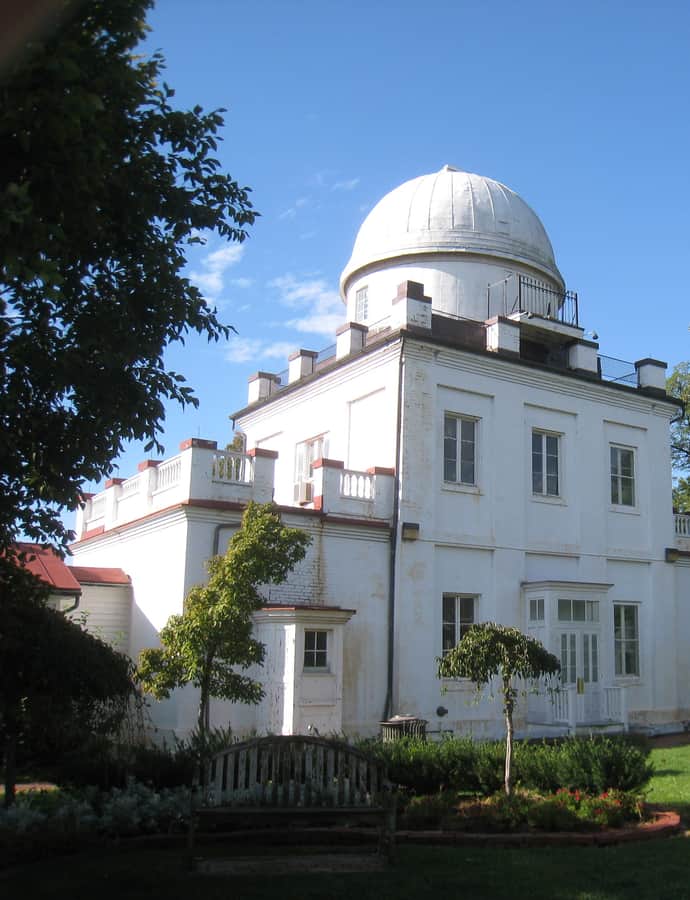

Father James Curley of Georgetown College's physics department founded this observatory in 1841, choosing the site, planning the building, and supervising construction through its completion in 1844. Fellow Georgetown professors Rev. Thomas Meredith Jenkins and Rev. Charles H. Stonestreet paid the initial costs, and Curley used the finished instrument in 1846 to fix the official latitude and longitude of Washington, D.C. One of the oldest astronomical observatories in the country, it is built in the Greek Revival style and is both a DC Historic Landmark and listed on the National Register of Historic Places.
the building
The 12-inch telescope. In 1888, director Johann Georg Hagen installed a 12-inch equatorial telescope that he used for twenty years to gather data on variable stars — an instrument still in continuous use today.
Fixing DC's coordinates. Curley used the observatory in 1846 to determine the official latitude and longitude of Washington, D.C., calculating 38°54′26″ north and 5h8m18.29s west of Greenwich.
Sunspot drawings. In 1850, Benedict Sestini used the observatory to produce a series of sunspot drawings, later engraved and published as 44 plates in the Naval Observatory's 1847 volume, printed in 1853.
the style
The observatory is built in the Greek Revival style, one of the features cited in its designation as a DC Historic Landmark and National Register listing.
More on Greek Revivalthe architect
James Curley was a Jesuit priest and physics professor at Georgetown College, not a professional architect by trade. He chose the observatory's hilltop site, planned the building himself, and supervised its construction from 1841 to completion in 1844, then used the finished instrument to calculate Washington's official latitude and longitude in 1846.
significance
The observatory — also known as the Heyden Observatory and Francis J. Heyden Observatory — is a DC Historic Landmark (#L_0123) and is listed on both the National Register of Historic Places and the District of Columbia Inventory of Historic Sites, recognized as one of the oldest astronomical observatories in the United States.
nearby
- Georgetown University, Old North
- Georgetown University, Healy Hall
- Lauinger Library
- Washington Canoe Club
- Georgetown Car Barn
- Prospect House (Lingan-Templeman House)