
Greyhound Bus Terminal
- Architect
- William Strudwick Arrasmith
- Year
- 1939
- Style
- Streamline Moderne
- City
- Washington, DC
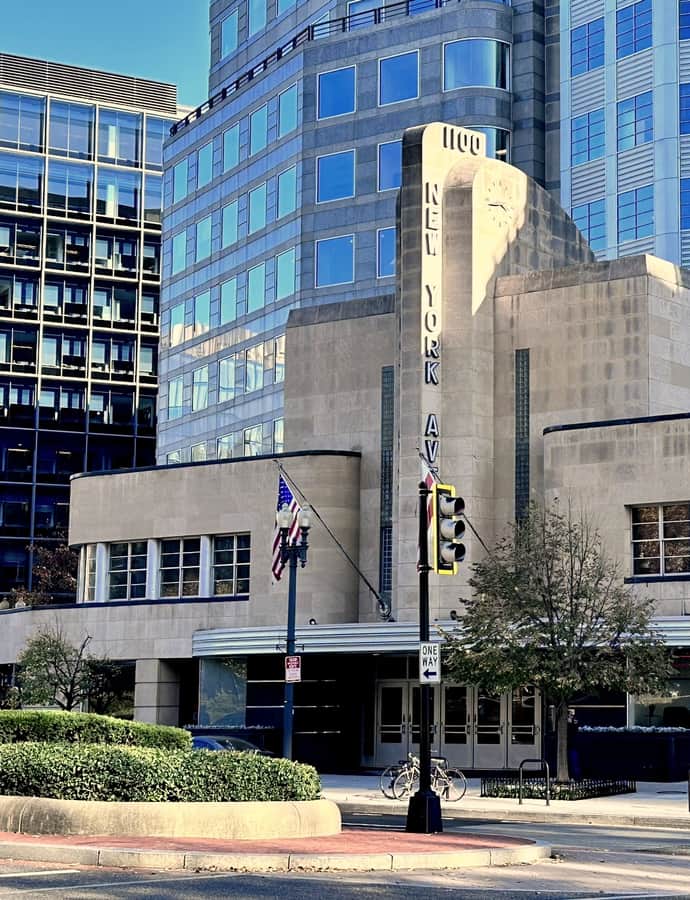

The Old Greyhound Terminal at 1100 New York Avenue NW served Greyhound Lines from 1940 into the 1980s, its permit fought over in a 1932 Public Utilities Commission hearing where streetcar operators objected but the Chamber of Commerce, Board of Trade, and Merchants and Manufacturers Associations backed the project. Designed by William Strudwick Arrasmith in the Streamline Moderne style, the terminal saw heavy use moving servicemen during World War II and played a minor role in the Civil Rights Movement. Preservationists saved it, and most of the original building was incorporated into the 1100 New York Avenue high-rise built in 1991.
the building
Saved inside a new tower. When preservationists intervened to save the terminal, most of the original building was incorporated into the new 1100 New York Avenue high-rise office building constructed in 1991, folding the Streamline Moderne terminal into a modern office tower rather than losing it outright.
A contested 1932 hearing. Before the terminal could be built, a September 1932 Public Utilities Commission hearing pitted the Washington Railway and Electric Company and the Short Lines, who opposed it, against the Washington Chamber of Commerce, Board of Trade, and Merchants and Manufacturers Associations, who supported it; a building permit was granted the following week.
the style
Arrasmith designed the terminal in the Streamline Moderne style, the sleek, aerodynamic idiom he used repeatedly for Greyhound terminals nationwide, built to signal speed and modern travel to bus passengers.
More on Streamline Modernethe architect
William Strudwick Arrasmith designed the terminal as one of his Greyhound bus stations.
significance
The terminal is a DC Historic Landmark (#L_0148) and listed on the District of Columbia Inventory of Historic Sites. It was used extensively to move servicemen during World War II and played a minor role in the Civil Rights Movement before preservationists secured its survival within the 1991 office tower now on the site.
nearby
- Chesapeake and Potomac Telephone Company, Old Main Building
- United Brotherhood of Carpenters and Joiners-Local 132 building
- Franklin, Benjamin, School (& Interiors)
- McLachlen Building
- Martin Luther King Jr. Memorial Library
- Church of the Epiphany