
Smithsonian Institution
- Architect
- James Renwick Jr.
- Year
- 1849
- Style
- Romanesque Revival
- City
- Washington, DC
- Collection
- romanesque revival
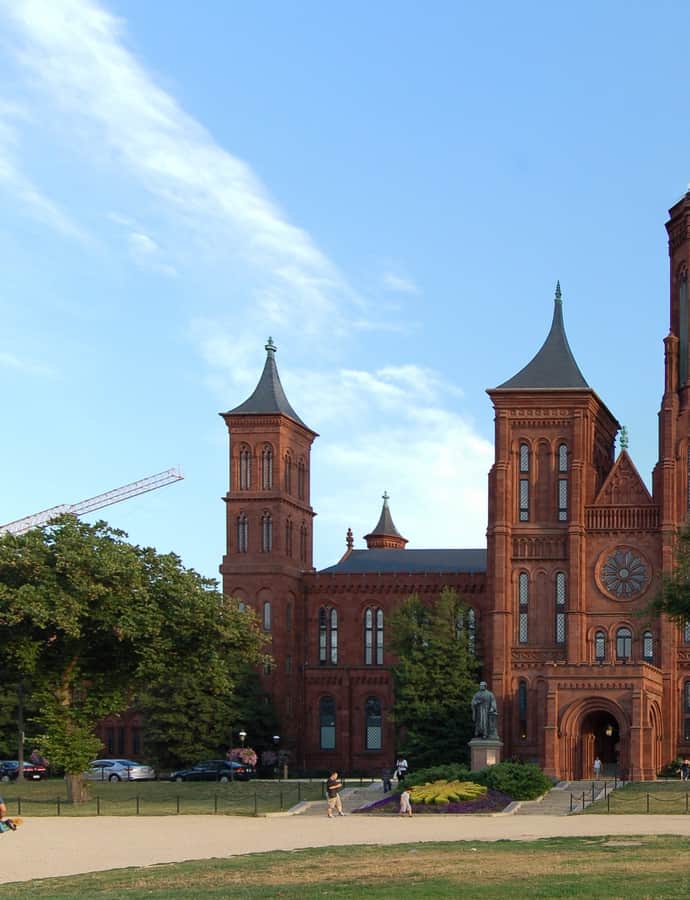

The Smithsonian Institution Building, universally known as the Smithsonian Castle, was the first building the young Smithsonian ever constructed for itself. James Renwick Jr. won the commission through a nationwide design competition in 1846, chosen by a unanimous vote of the building committee, and the Castle was completed in 1855 in red Seneca sandstone. It set the Smithsonian's public face on the National Mall and still holds the institution's administrative offices and visitor information center.
the building
Seneca sandstone walls. The Castle is built of Seneca red sandstone rather than the white marble common to Washington's monumental buildings, giving it a warm, fortress-like color that sets it apart on the Mall. The style is a Norman Revival, recalling a 12th-century combination of late Romanesque and early Gothic motifs, blending round arches with pointed Gothic detailing.
The winning design. In 1846 the Smithsonian's building committee held a nationwide competition for the design and picked Renwick's scheme by unanimous vote. A cardboard model of that winning design has survived and is still on display inside the Castle today.
First Smithsonian building. Built as the very first Smithsonian museum building, the Castle originally organized the institution's early collecting and research work under one roof. It continues to serve as the Smithsonian's administrative headquarters and the visitor information center for the entire Institution.
the style
The Castle is worked in a Norman Revival mode, recalling a 12th-century combination of late Romanesque and early Gothic motifs, and is often described as blending the Gothic and Romanesque revival styles. Look for the round Romanesque arches paired with pointed Gothic-derived towers and turrets across the sandstone facade.
More on Romanesque Revivalthe architect
James Renwick Jr. designed the Castle after winning the Smithsonian's 1846 nationwide competition. He went on to design St. Patrick's Cathedral in New York City and, later in Washington, the Smithsonian's own Renwick Gallery. His runner-up design for the Castle competition, done in Gothic Revival style, was later used for Trinity Episcopal Church. Renwick was assisted on the Castle by Robert Mills.
significance
The Smithsonian Institution Building was designated a National Historic Landmark in 1965. It is also listed on the National Register of Historic Places, the District of Columbia Inventory of Historic Sites, and as DC Historic Landmark #L_0098.
nearby
- Freer Gallery of Art
- Arts and Industries Building, Smithsonian Institution (National Museum)
- Hirshhorn Museum and Sculpture Garden
- National Museum of Natural History, Smithsonian Institution
- Jamie L. Whitten Building
- U.S. Department of Agriculture Cotton Annex