
Littlefield House
- Year
- 1962
- Style
- Second Empire
- City
- Austin, TX
- Collection
- victorian austin
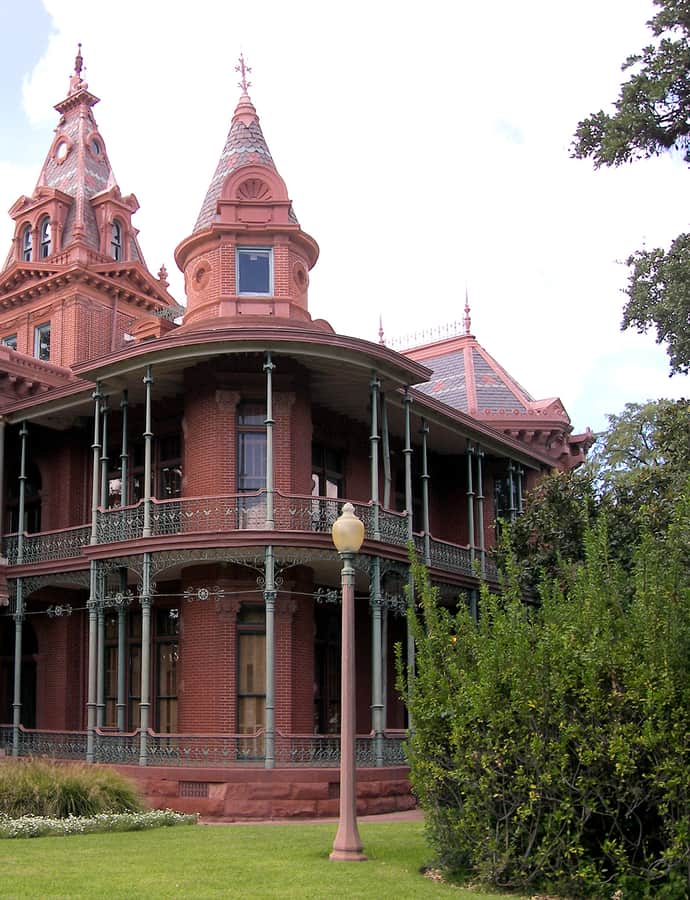

The Littlefield House is a Second Empire mansion built in 1893 on the University of Texas at Austin campus for Civil War veteran George Littlefield, a bank and cattle magnate, at a cost of $50,000. Littlefield and his wife Alice became major UT benefactors, funding the Littlefield Fountain, the Main Building, and the Littlefield Dormitory. When Alice died in 1935 she left the house to the university, and it was added to the National Register of Historic Places in 1970.
the building
The mansard roof. Built for $50,000 in the Second Empire idiom, the house is defined by its notable mansard roof, the style's signature move within Austin's Victorian building stock and the detail that still marks it as a landmark on campus at 24th and Whitis streets.
The Deodar Cedar. George Littlefield had a Deodar Cedar, or Himalayan cedar (Cedrus deodara), imported from the Himalayas for the property. He had the soil where it was to be planted dug up and replaced before the tree went into the ground.
Downtown twin. While living in the house, the Littlefields also developed the Littlefield Building downtown, a commercial counterpart to their campus mansion that was finished in 1912.
Life after Alice. After Alice Littlefield's 1935 bequest, the house passed to the university. Today its ground floor is refurbished for university functions, while the upstairs serves as office space for the Office of University Events.
the style
The house was designed in the Second Empire style, popular among Victorian-era Texas homes, best recognized here by its steep mansard roof. That roofline, more than any single ornament, is what still reads as "landmark" to passersby at 24th and Whitis.
More on Second Empiresignificance
Recorded Texas Historic Landmark and listed on the National Register of Historic Places in 1970. Bequeathed to the University of Texas by Alice Littlefield in 1935, it remains in active university use today.
nearby
- Main Building
- Battle Hall
- University Baptist Church
- Texas Federation of Women's Clubs Headquarters
- Neill-Cochran House
- Goodall Wooten House