
Bedford Block
- Architects
- Charles Amos Cummings Willard Thomas Sears
- Year
- 1874
- Style
- Venetian Gothic
- City
- Boston, MA
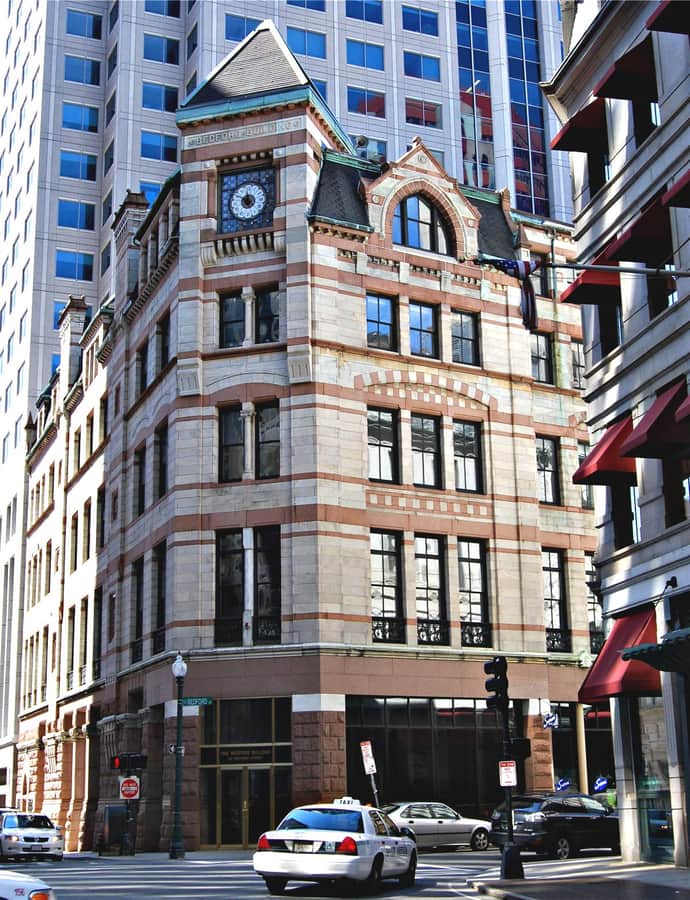

The Bedford Block is a commercial building at 99 Bedford Street facing Church Green, designed by Charles Amos Cummings and Willard T. Sears and completed in 1874-75 in the Venetian Gothic style championed by the critic John Ruskin, a style rarely attempted locally. It was the first building erected after the Great Fire of Boston to use New Brunswick red granite, and it was added to the National Register of Historic Places in 1979.
the building
Polychrome facade. The exterior bands together New Brunswick red granite, Tuckahoe marble, and pressed terra-cotta panels manufactured in Philadelphia, creating the polychromatic effect central to the Ruskinian Venetian Gothic look.
Tower clock and ironwork. Rough rustic stonework covers the ground floor, while upper floors carry arched bay windows and Viollet-le-Duc-inspired iron balconets under gables each topped with a finial crown; a glazed tile clock sits in the five-story tower at the building's northeast corner.
the style
Cummings and Sears built the Bedford Block in Venetian Gothic, the polychrome masonry style promoted by John Ruskin, making it one of Boston's rare surviving local examples of the idiom.
More on Venetian Gothicthe architect
Charles Amos Cummings and Willard Thomas Sears designed the Bedford Block together in 1874-75, giving Church Green one of the city's few Venetian Gothic commercial buildings.
significance
The Bedford Block was listed on the National Register of Historic Places in 1979.
nearby
- United Shoe Machinery Corporation Building
- Holy Cross Church, Boston
- South Station Tower
- Filene's Department Store
- Blake and Amory Building
- Compton Building