
Faneuil Hall
- Style
- Georgian
- City
- Boston, MA
- Collection
- colonial & revolutionary
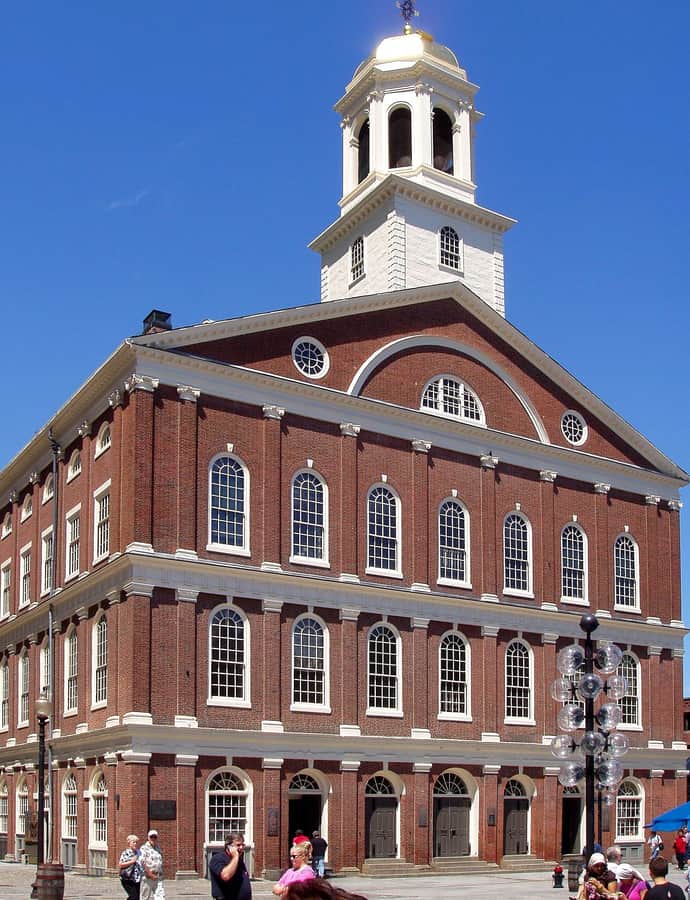

Faneuil Hall opened in 1742 as a marketplace and meeting hall designed by the artist John Smibert, and became known as the 'Cradle of Liberty' for the speeches and debates held there in the years before the American Revolution. Owned by the city of Boston and now part of Boston National Historical Park, it remains a working marketplace on its ground floor beneath the historic meeting hall above.
the building
Rebuilt after fire, then rebuilt again. The original 1742 building burned in 1761 and was rebuilt over the following decade. It was later remodeled and expanded by Charles Bulfinch in 1806, renovated again in 1827 after the opening of nearby Quincy Market, and had its interiors rebuilt in noncombustible materials in 1898-1899.
A market with a meeting hall above. From the start the building combined a ground-floor marketplace with the Great Hall meeting room above it, a pairing of commerce and civic assembly that gave the building much of its symbolic weight as the 'Cradle of Liberty.'
the style
Faneuil Hall was built in the Georgian style typical of colonial New England public buildings, a form solid and restrained enough to survive multiple fires, expansions, and renovations - by Bulfinch in 1806 and by the firm Cram and Ferguson between 1923 and 1925 - without losing its original character.
More on Georgiansignificance
Faneuil Hall is a National Historic Landmark and is individually listed on the National Register of Historic Places, part of Boston National Historical Park, and was approved as Boston Landmark #102 on December 13, 1994.
nearby
- Quincy Market Building
- Boston City Hall
- Union Oyster House
- Second Brazer Building
- Old State House
- Ames Building