
George R. Minot House
- Style
- Colonial Revival
- City
- Boston, MA
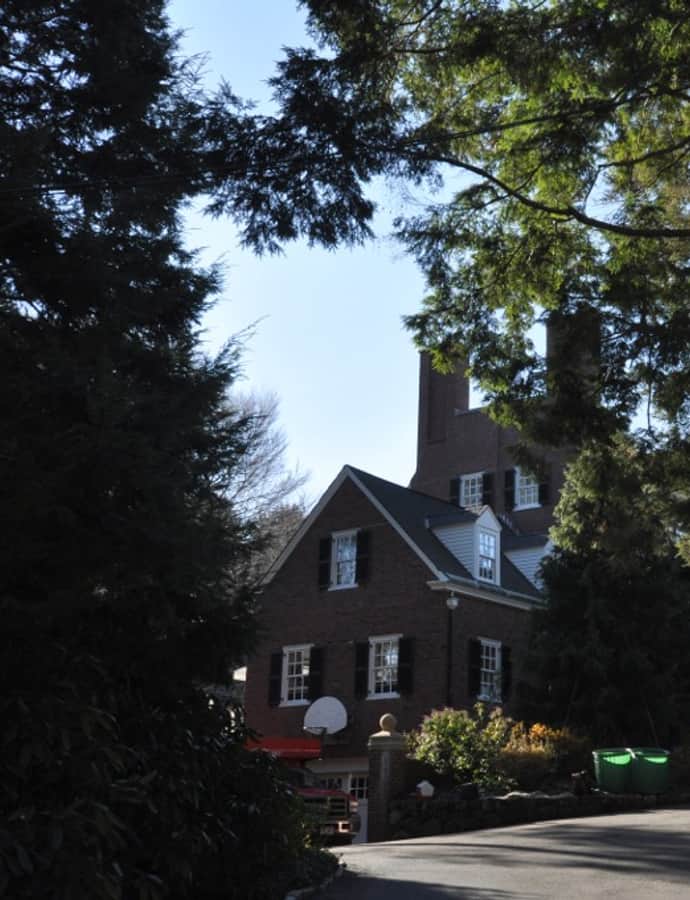

The George R. Minot House is a Colonial Revival brick house in Brookline, probably built in the 1920s, that the federal government designated a National Historic Landmark not for its architecture but for the man who lived there. Dr. George R. Minot, who worked here, won the 1934 Nobel Prize in Physiology or Medicine for discovering a cure for pernicious anemia.
the building
An undistinguished landmark. The house itself is plain — a 2½-story brick main block with an attached 1½-story ell, twin end chimneys, and a hip roof pierced by gabled dormers, with a pedimented portico over the front door. Its National Historic Landmark status rests entirely on its occupant, not its design.
the style
Colonial Revival, described in the National Register record as 'architecturally undistinguished' — a vernacular brick house built to the pattern-book conventions of 1920s Brookline rather than any special design ambition.
More on Colonial Revivalsignificance
Designated a National Historic Landmark and listed on the National Register of Historic Places as the home of Dr. George R. Minot (1885-1950), who did his groundbreaking anemia research as chief of medical services at Boston's Collis Huntington Memorial Hospital in the 1920s and later at the Thorndike Memorial Laboratory of Boston City Hospital. He was a Harvard Medical School professor and the first American to receive the Moxon Medal.
nearby
- Perkins Estate
- Ebenezer Heath House
- Brandegee Estate
- Adams-Nervine Asylum
- First Church of Jamaica Plain
- Metropolitan Waterworks Museum