
Simmons-Edwards House
- Style
- Federal
- City
- Charleston, SC
- Collection
- antebellum charleston
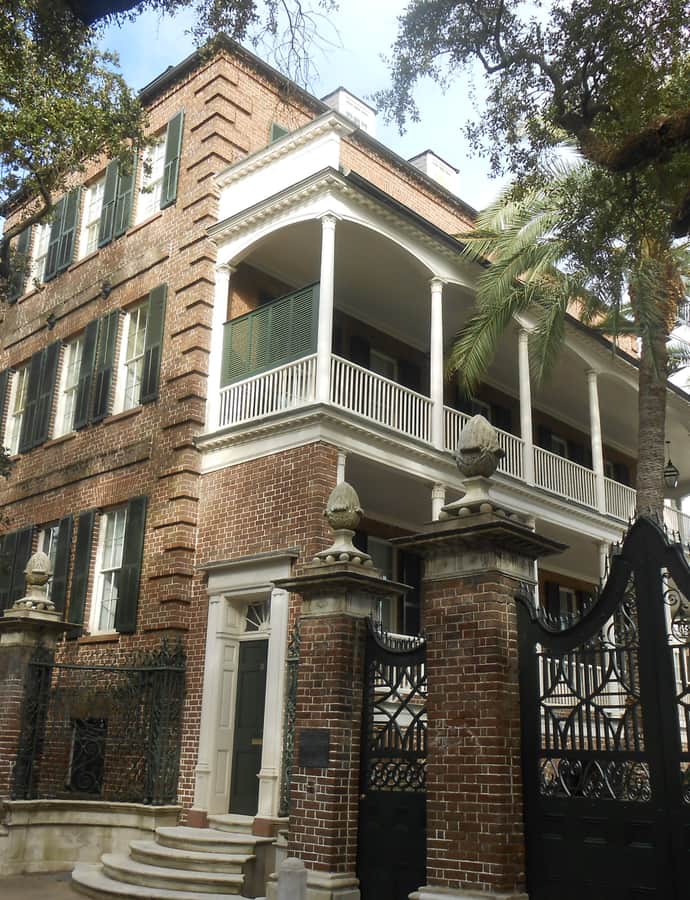

The Simmons-Edwards House at 14 Legare Street was built around 1800 for Francis Simmons, a planter from Johns Island. It's popularly known as the Pineapple Gates House for its large brick gateposts and decorative wrought iron, whose finials were carved to resemble Italian pinecones but are locally read as pineapples. It was declared a National Historic Landmark in 1973.
the building
The Pineapple Gates. The house's famous brick gates, topped with iron finials carved to resemble Italian pinecones, were installed by George Edwards, who owned the property until 1835 and whose initials the gates bear. Charlestonians read the finials as pineapples, giving the house its popular name.
The 1816 garden enlargement. In 1816, George Edwards enlarged the grounds and laid out a garden, separating it from the house yard with a wrought-iron fence carried on stuccoed columns topped with sandstone balls.
the style
The house is a large, neoclassical Charleston single house, a local building form later dressed up with the Federal-era ironwork that made it famous.
More on Federalsignificance
Declared a National Historic Landmark in 1973, the house was later home to James Adger Smyth, mayor of Charleston from 1879 until his death in 1920.
nearby
- Cleland Kinloch and Burnet R. Maybank Huger House
- Unitarian Church in Charleston
- Miles Brewton House (Charleston)
- Colonel John Stuart House
- Nathaniel Russell House
- Edward Rutledge House