
Central Park Theater
- Architect
- Rapp and Rapp
- Year
- 1917
- Style
- Spanish Colonial Revival
- City
- Chicago, IL
- Collection
- movie palaces
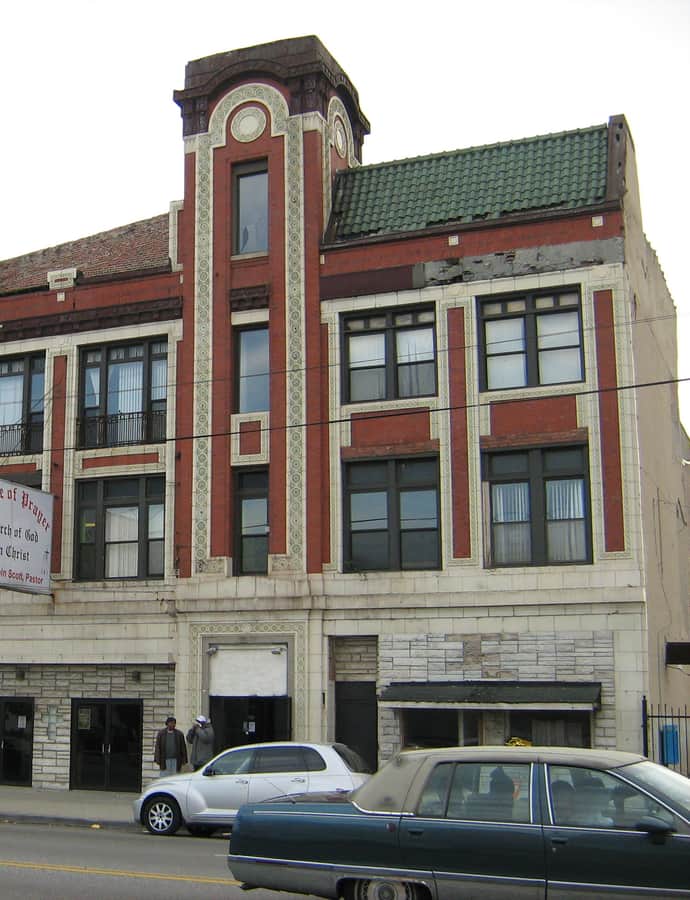

Central Park Theater opened in 1917 at 3531-39 W. Roosevelt Road as the flagship of a new chain: Balaban and Katz's very first movie palace. Rapp and Rapp, the Chicago firm that designed it, parlayed the commission into becoming the main architects for the entire Balaban and Katz circuit and later for Paramount Pictures. It served Lawndale's Jewish community for decades, then the African American community that replaced it after the 1950s.
the building
Twin towers and terra cotta. The Spanish Revival facade is anchored by two prominent towers rising above Roosevelt Road, faced in red brick and dressed with ornamental terra cotta -- a showy street presence meant to announce a movie palace rather than a neighborhood storefront.
First air-conditioned theater. Central Park Theater was the first theater in the world to install mechanical air conditioning, a novelty the Balaban and Katz chain advertised heavily during Chicago summers to pull audiences in off the sidewalk.
the style
Rapp and Rapp dressed the theater in Spanish Colonial Revival forms -- an exotic, escapist idiom common to the movie palace boom of the 1910s, meant to transport moviegoers away from the working streets of Lawndale the moment they stepped through the doors.
More on Spanish Colonial Revivalthe architect
Rapp and Rapp were a Chicago firm best known for movie palaces; Central Park Theater was their debut for Balaban and Katz, and the success of the design made them the chain's principal architects and, later, house architects for Paramount Pictures.
significance
Central Park Theater is listed on the National Register of Historic Places (added August 10, 2005) and is one of the few Lawndale businesses surviving from the early twentieth century. Converted to the House of Prayer, Church of God in Christ in 1971, it has functioned as a church ever since -- and its interior later inspired the video game map Kino Der Toten in Call of Duty: World at War.
nearby
- Sears, Roebuck and Company Complex
- (Former) Anshe Sholom Synagogue Building
- King-Nash House
- Shedd Park Fieldhouse
- Henry E. Legler Regional Branch of the Chicago Public Library
- Waller Apartments