
Civic Opera Building
- Architect
- Graham, Anderson, Probst & White
- Year
- 1927
- Style
- Art Deco
- City
- Chicago, IL
- Collection
- chicago deco
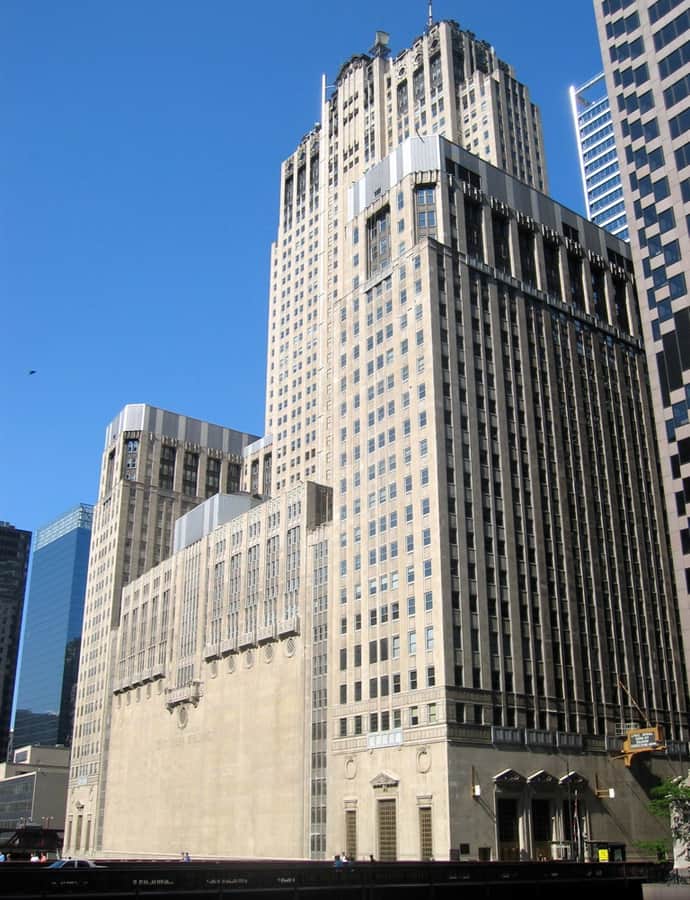

Utilities magnate Samuel Insull envisioned and financed the Civic Opera House to give the Chicago Civic Opera a permanent home, hiring Graham, Anderson, Probst & White to design it. The Art Deco complex at 20 North Wacker Drive opened November 4, 1929, pairing the opera house with a 45-story office tower and two 22-story wings; its chair-like silhouette earned it the nicknames "Insull's Throne" and "Insull's Folly."
the building
The auditorium. Now named for Ardis Krainik, the main performance hall seats 3,276, the second-largest opera auditorium in North America after the Metropolitan Opera House. It has housed the Lyric Opera of Chicago since 1954 and the Joffrey Ballet since 2021.
A chair-shaped complex. The 45-story office tower and its two flanking 22-story wings give the building its nickname; wedged onto its Wacker Drive site, the massing has been described as a huge chair facing the Chicago River.
the style
Graham, Anderson, Probst & White, the firm behind the Merchandise Mart and the former Morton Salt headquarters next door at 110 N Wacker, gave the Civic Opera Building its Art Deco details, dressing Insull's opera house in the era's newest commercial style.
More on Art Decothe architect
Graham, Anderson, Probst & White was responsible for numerous buildings across the downtown Loop, including the Art Deco Merchandise Mart and the former Morton Salt headquarters building next door at 110 N Wacker, built in the 1950s.
significance
The Civic Opera Building was designated a Chicago Landmark (L-72) on February 5, 1998.
nearby
- Gage Group Buildings
- Illinois Bell Building
- First Leiter Building
- 151 North Franklin
- 300 West Adams Street Office Building
- 181 West Madison Street