
Grant-Humphreys Mansion
- Architect
- Boal and Harnois
- Year
- 1902
- Style
- Neoclassical
- City
- Denver, CO
- Collection
- the city beautiful
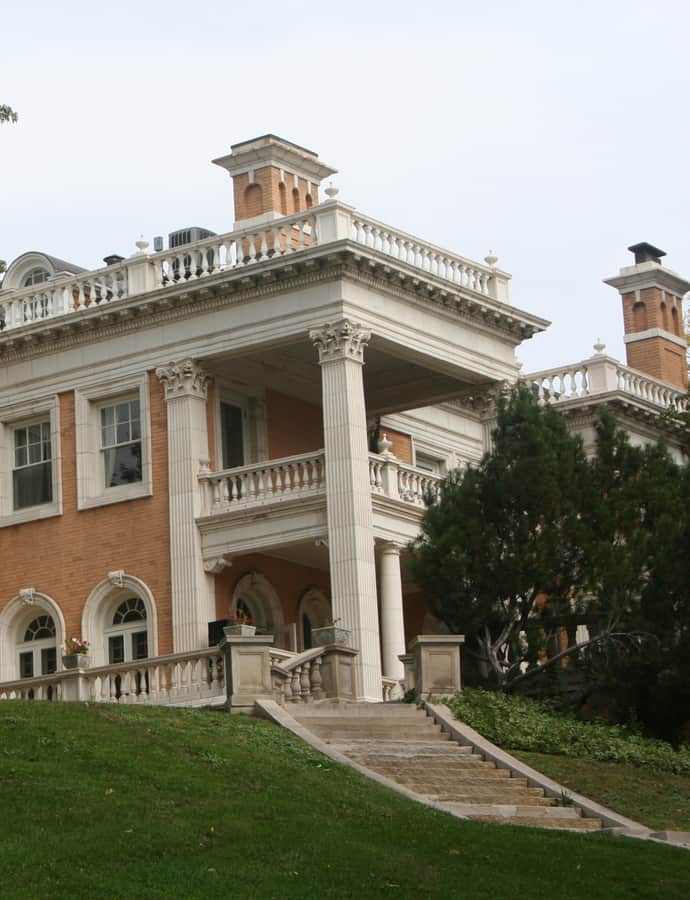

Built in 1902 in the Neoclassical style by architects Boal and Harnois, this Denver mansion was raised for James Benton Grant, Colorado's third governor, who made his fortune in ore smelting — his Grant Smelting Company operated the tallest furnace stack in the country and the third-tallest in the world. After Grant's death in 1911, his widow Mary lived on in the house until 1917, when she sold it to oil wildcatter Albert E. Humphreys.
the building
The smelting fortune. James Benton Grant built his wealth in ore smelting, first in Leadville and then in Denver, where his Grant Smelting Company, two miles northeast of downtown, boasted the tallest furnace stack in the country and the third-largest in the world. That fortune financed this house following his single term as governor, from 1883 to 1885.
A wildcatter's house. Mary Goodell Grant, a prominent Denver society figure and Daughters of the American Revolution member who helped found a home for destitute children, sold the house in 1917 to Albert E. Humphreys. Known as "The Wildcatter Deluxe" and "King of the Wildcatters," Humphreys made his money striking oil in Wyoming, Oklahoma, and Texas.
the style
The Neoclassical design suited a house built for a former governor, giving the mansion a formal civic presence that carried over when oil wildcatter Albert E. Humphreys bought it in 1917.
More on Neoclassicalsignificance
The mansion holds Denver Landmark status (#95), is listed on the National Register of Historic Places, and is designated a Denver Historical Landmark.
nearby
- Colorado Governor's Mansion
- Bennett-Field House
- Kistler-Rodriguez House
- Town Club/Crawford Hill House
- Croke-Patterson-Campbell House
- Leeman Auto Company Building