
Bradbury Building
- Architect
- Sumner Hunt
- Year
- 1893
- Style
- Renaissance Revival
- City
- Los Angeles, CA
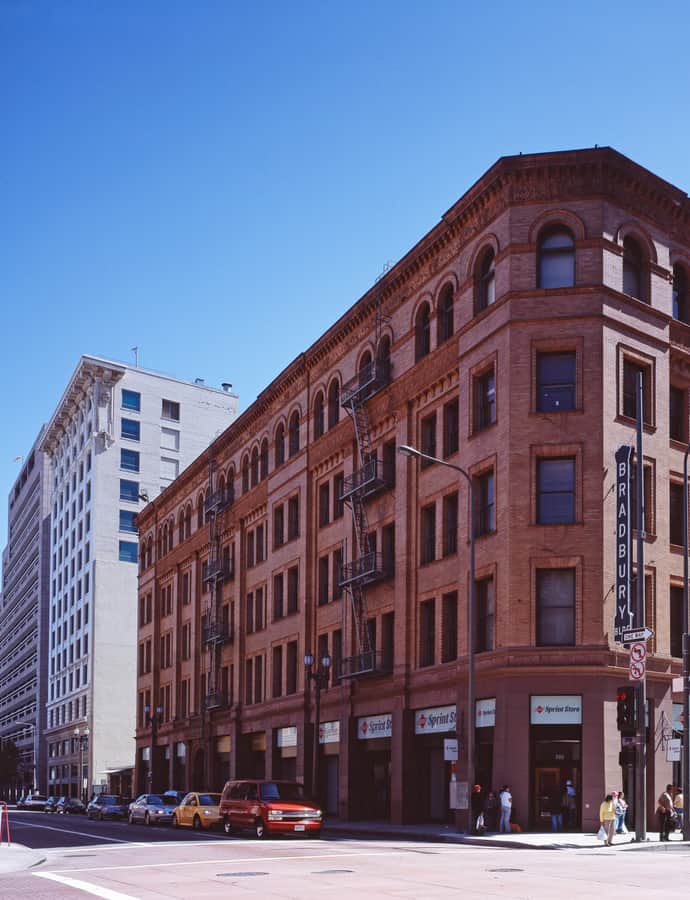

Lewis L. Bradbury, a gold-mining millionaire, commissioned the five-story office building that bears his name in 1893, but he died before it was finished; architect George Wyman ended up constructing it from an original design by Sumner Hunt. Its extraordinary skylit atrium of iron staircases, walkways, and open-cage elevators makes it one of only four Los Angeles office buildings ever designated a National Historic Landmark.
the building
The skylit atrium. Ornate ironwork frames the access walkways, staircases, and elevators that rise through the building's open, glass-roofed atrium — the interior spectacle the Bradbury is known for far more than its exterior.
Two architects, one building. Sumner Hunt produced the original design, but it was George Wyman who ultimately built the Bradbury Building, an unusual handoff for a building this celebrated.
A recurring film set. The atrium's dramatic ironwork has drawn film, television, and music video productions for decades, giving the Bradbury a long career as a location as well as a workplace.
the style
The exterior reads as Renaissance Revival by way of Mediterranean Revival massing, a relatively restrained facade that gives no hint of the ironwork spectacle inside.
More on Renaissance Revivalthe architect
Sumner Hunt produced the Bradbury's original design; George Wyman, credited as the constructing architect, carried the five-story building to completion in 1893.
significance
Added to the National Register of Historic Places in 1971 and declared a National Historic Landmark in 1977, the Bradbury is one of only four Los Angeles office buildings so honored, and — protected as Historic-Cultural Monument No. 6 since 1962 — it's also the city's oldest landmarked building.
nearby
- Million Dollar Theater Building
- Broadway Mart Center
- Continental Building
- Judson Rives Building
- Higgins Building
- San Fernando Building