
The Cabildo
- Year
- 1795
- Style
- Baroque
- City
- New Orleans, LA
- Collection
- the french quarter
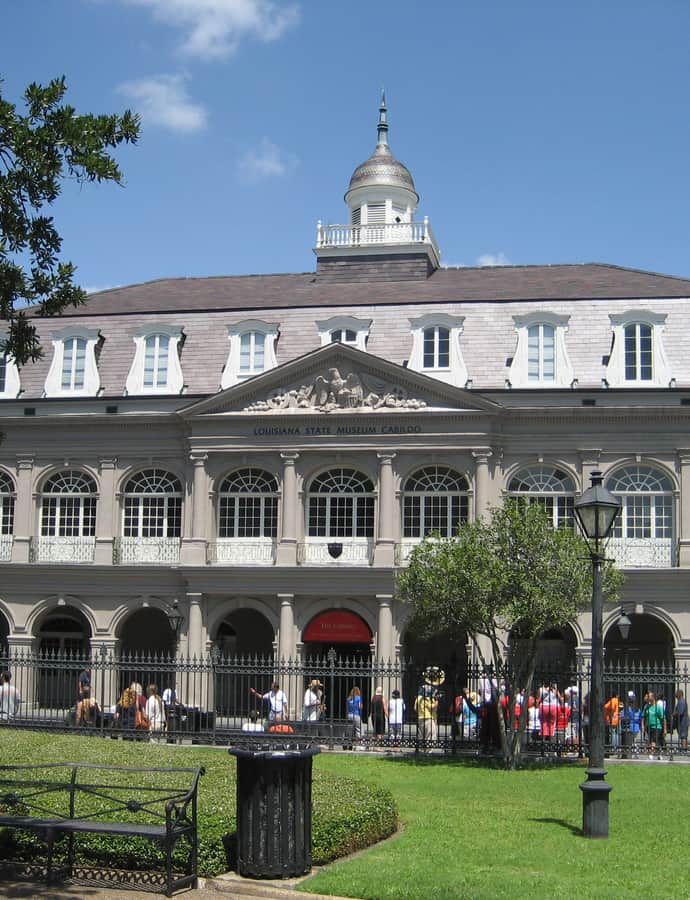

The Cabildo was rebuilt between 1795 and 1799 as the seat of the Spanish colonial government in New Orleans, replacing an earlier building lost in the Great New Orleans Fire of 1788. Standing on Jackson Square beside St. Louis Cathedral, it took its name from the 'Illustrious Cabildo,' the city council that met there, and was the site of the Louisiana Purchase transfer ceremonies in late 1803. It is a National Historic Landmark.
the building
An eagle replaces a crown. In 1821 the Spanish coat of arms was stripped from the facade pediment and replaced with an American eagle grasping cannonballs, carved by the Italian sculptor Pietro Cardelli — a literal rewriting of the building's allegiance in stone.
A mansard afterthought. A third floor topped with a French-style mansard roof was added in 1847, decades after the original structure went up, changing the building's silhouette on Jackson Square.
The Sala Capitular. The building's main hall, the Sala Capitular ('Meeting Room'), originally served as a courtroom, used by the Spanish from 1799 to 1803 and continuing in judicial use for years after.
the style
The Cabildo was rebuilt in the Baroque style typical of Spanish colonial civic buildings, its appearance since layered with later additions, including an 1847 mansard roof and 1821 American ornament, atop the 1795 structure.
More on Baroquesignificance
The Cabildo is a National Historic Landmark and National Register of Historic Places listed site, and it was the location of the Louisiana Purchase transfer ceremonies in late 1803. It now forms part of the Louisiana State Museum.
nearby
- St. Louis Cathedral
- The Presbytere
- Pontalba Buildings
- Napoleon House
- Madame John's Legacy
- Louisiana State Bank Building