
The Presbytere
- Style
- Baroque
- City
- New Orleans, LA
- Collection
- the french quarter
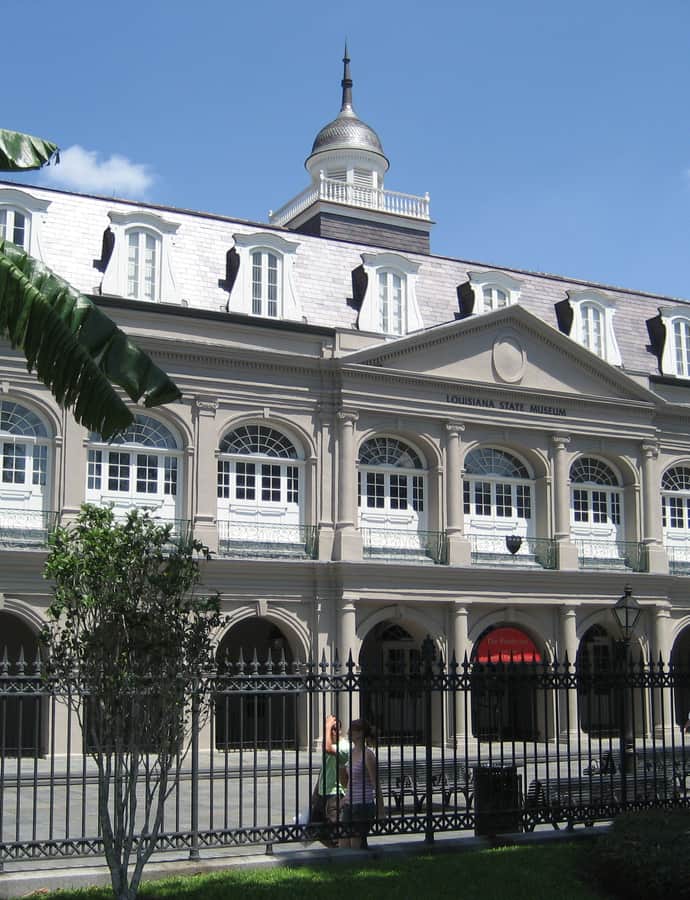

The Presbytère was built starting in 1813 as a matching companion to the Cabildo, flanking St. Louis Cathedral on the opposite side of Jackson Square. Designed in 1791 by a French-born architect, it is one of the nation's best surviving examples of formal colonial Spanish architecture, blended with neo-Renaissance elements. It was designated a National Historic Landmark in 1970 and is now operated as a property of the Louisiana State Museum.
the building
The nine-bay arcade. The ground floor is fronted by a nine-bay open arcade of elliptical arches with pilastered corners, while the upper level repeats the arched-and-pilastered rhythm with multipane windows above.
A later mansard roof. The building originally had a flat roof topped by a balustrade and urns. In 1847 a dormered mansard roof was added, capped by a louvered cupola — the profile most visitors see on Jackson Square today.
the style
The Presbytère is considered one of the nation's best examples of formal colonial Spanish architecture, with neo-Renaissance elements layered in, particularly in the center three bays where engaged columns rise through both stories to a gabled pediment.
More on Baroquesignificance
Designated a National Historic Landmark in 1970, the Presbytère now belongs to the Louisiana State Museum, having been built specifically to match the Cabildo across Jackson Square.
nearby
- St. Louis Cathedral
- Madame John's Legacy
- Pontalba Buildings
- The Cabildo
- Lafitte's Blacksmith Shop
- Napoleon House