
Hopkins Store
- Architect
- James Bogardus
- Year
- 1865
- Style
- Italianate
- City
- Manhattan, NY
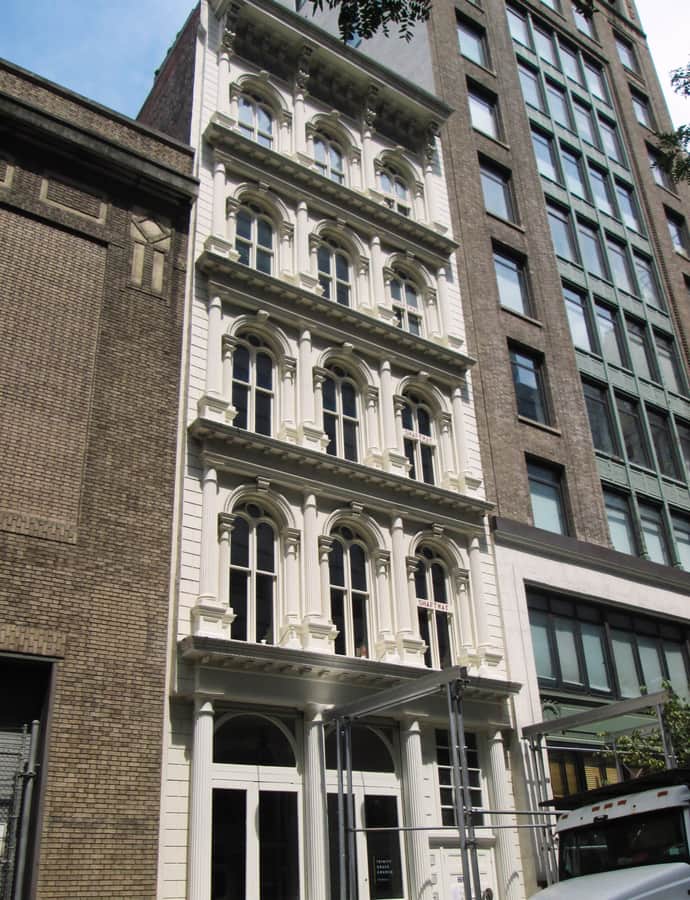

The Hopkins Store at 75 Murray Street is a cast-iron building from 1857-58, built for glassware dealers Francis and John Hopkins. Its facade came from the foundry of James Bogardus, the self-described inventor of cast-iron architecture, and it survives as one of the earliest examples of his system still standing.
the building
Cast-iron facade. The front is cast iron rather than masonry, poured in a Venetian Renaissance idiom from Bogardus's foundry. Cast iron let ornament be produced from reusable molds rather than carved by hand, and it could be painted to imitate stone.
Later tenants. Around 1920 the building became home to Knickerbocker Annunciator, a supplier of elevator traveling cable, electronic cable, and annunciators, well after the Hopkins glassware business that gave the building its name had gone.
the style
The facade is worked in the Venetian Renaissance style, translated into cast iron rather than carved stone. That substitution is the point: Bogardus's system let a foundry cast the same decorative elements Venetian palazzo builders had chiseled by hand, then bolt them to the front of a commercial building.
More on Italianatethe architect
James Bogardus was a self-described inventor who pioneered cast-iron construction in the mid-19th century. The Hopkins Store is one of the earliest of his few remaining facades, making it a rare surviving example of the system he championed.
significance
The building is a New York City Individual Landmark (LP-00601) and is listed on the National Register of Historic Places, designated on 12/10/1968. It was converted to mixed commercial and residential use in 1994-95 and restored, and is now known as the Bogardus Mansion, used for events and musical performances.
nearby
- Cary Building
- Barclay-Vesey Building
- 90 Church Street
- 30 Park Place
- Saint Peter's Roman Catholic Church
- Home Life Insurance Company Building