
Union Trust Building
- Architect
- Frederick J. Osterling
- Year
- 1916
- Style
- Renaissance Revival
- City
- Pittsburgh, PA
- Collection
- steel city beaux-arts
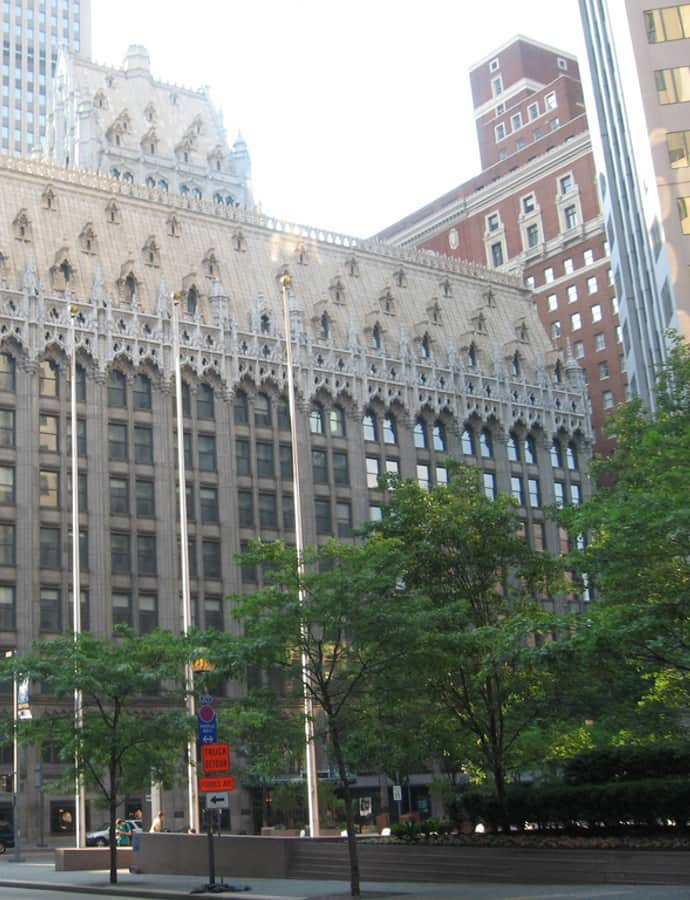

The Union Trust Building rises at 501 Grant Street in Downtown Pittsburgh, erected in 1915-16 for industrialist Henry Clay Frick on the site of the city's former St. Paul's Catholic Cathedral. Designed by Frederick J. Osterling in a Flemish-Gothic vocabulary, it originally served not as offices but as the Union Arcade, a shopping arcade of 240 shops and galleries.
the building
The Union Arcade. Known originally as the Union Arcade, the building held 240 shops and galleries, organized around a central rotunda capped by a stained glass dome - a shopping complex rather than a conventional office block.
Mansard roof and chapel-like towers. The mansard roof is trimmed with terra cotta dormers and topped by two mechanical towers styled to resemble chapels, carrying the building's Gothic detailing all the way to its silhouette.
Echoes of European town halls. No single model has been confirmed for the design, but Brussels Town Hall and Leuven Town Hall - both Brabantine Gothic landmarks - along with the newly completed Woolworth Building in New York, have all been suggested as influences.
the style
The building is often catalogued as Renaissance Revival but reads on the street as Flemish Gothic, its steep mansard roof, terra cotta dormers, and pointed detailing borrowed from the town halls of the Low Countries rather than from Renaissance Italy.
More on Renaissance Revivalthe architect
Frederick J. Osterling was a prominent Pittsburgh architect who designed the Union Trust Building for Henry Clay Frick; credit for the design has also been partially attributed to his collaborator Pierre A. Liesch, a Luxembourg-born architect who later used a similar Flemish Gothic style for the Croatian Fraternal Union Building.
significance
The Union Trust Building is listed on the National Register of Historic Places and recognized as a Pittsburgh History & Landmarks Foundation Historic Landmark.
nearby
- BNY Mellon Center
- Frick Building
- Kaufmann's Building
- Allegheny County Courthouse
- Trinity Cathedral
- Old Allegheny County Jail