
Symphony Hall
- Year
- 1900
- Style
- Renaissance Revival
- City
- Boston, MA
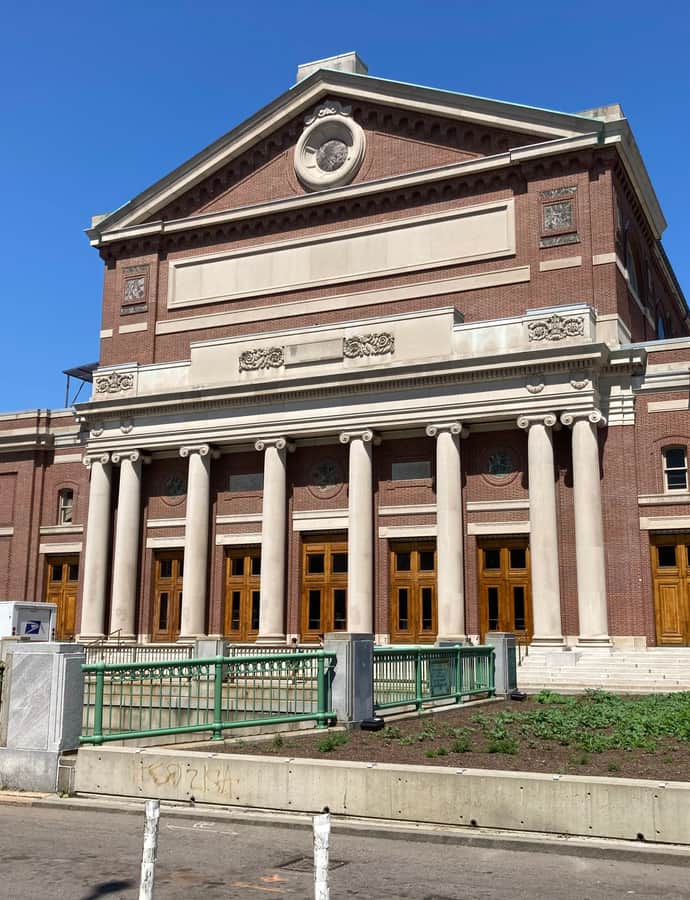

Symphony Hall was commissioned by Boston Symphony Orchestra founder Henry Lee Higginson from the firm McKim, Mead and White after the orchestra's original home, the Old Boston Music Hall, was threatened by road-building and subway construction. Ground broke in June 1899 and the 2,625-seat hall opened in 1900, built in the Renaissance style at 301 Massachusetts Avenue.
the building
Acoustics built on purpose. Symphony Hall is still ranked among the top three concert halls in the world for sound, sharing that distinction with the Amsterdam Concertgebouw and Vienna's Musikvereinsaal — a standing that makes it the finest concert hall in the United States.
A neighborhood of music. The hall sits one block from Berklee College of Music and one block from the New England Conservatory, and it also serves today as home to the Boston Pops and the site of concerts by the Handel and Haydn Society.
the style
Symphony Hall was built in the Renaissance architectural style, giving Higginson's concert house the dignified civic presence of a permanent institutional home after years spent in the threatened Old Boston Music Hall.
More on Renaissance Revivalthe architect
McKim, Mead and White, the firm commissioned by BSO founder Henry Lee Higginson, was one of the most prominent American architecture practices of the era, and Symphony Hall stands as one of its notable public commissions in Boston.
significance
Symphony Hall was designated a U.S. National Historic Landmark in 1999 and is a pending Boston Landmark; it is also listed on the National Register of Historic Places.
nearby
- New England Conservatory/Jordan Hall (ext&int)
- Boston Young Men's Christian Association
- Four Seasons Hotel & Private Residences, One Dalton Street
- New Riding Club
- Massachusetts Historical Society
- Union Church