
Carpenters' Hall
- Architect
- Robert Smith
- Style
- Georgian
- City
- Philadelphia, PA
- Collection
- colonial & revolutionary
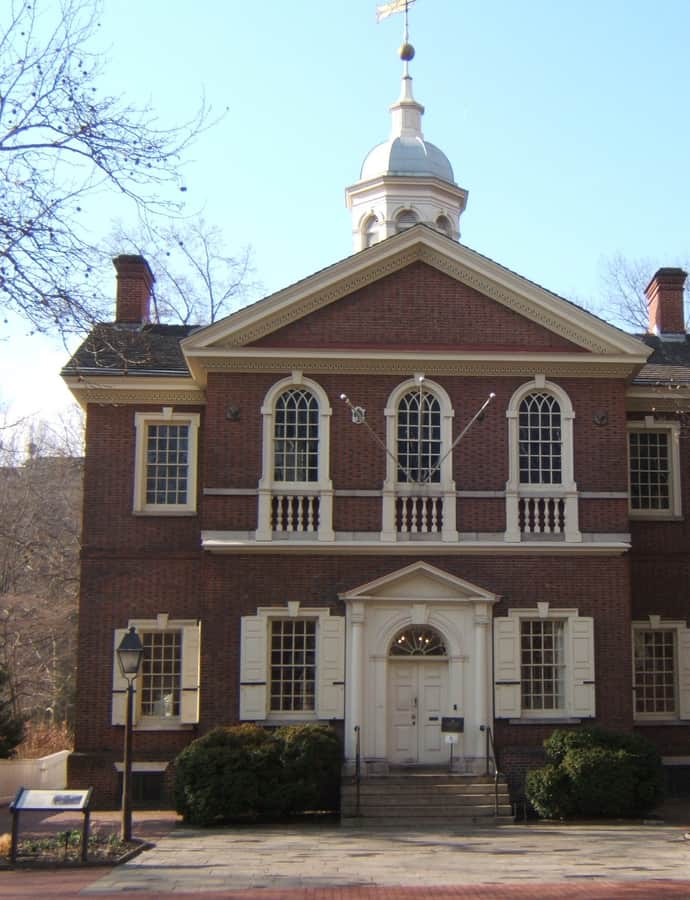

Carpenters' Hall, completed in 1775, was built by and for the Carpenters' Company of the City and County of Philadelphia — the country's oldest extant craft guild — with its member Robert Smith serving as architect. Before the two-story brick hall was even finished, the First Continental Congress met there in 1774, and in June 1776 the Pennsylvania Provincial Conference used it to declare the Province's independence from the British Empire and establish the Commonwealth of Pennsylvania.
the building
A guild's own hall. Carpenters' Hall was built for, and is still privately owned by, the Carpenters' Company — making it a rare Revolutionary-era landmark that has never left the hands of the trade guild that built it.
Birthplace of Pennsylvania. In June 1776, the Pennsylvania Provincial Conference met here to declare the Province's independence from the British Empire, establish the Commonwealth of Pennsylvania, and mobilize its militia — weeks before the Declaration of Independence was signed nearby.
the style
Carpenters' Hall is a modest two-story brick Georgian meeting hall, built by its own membership of master craftsmen rather than for a wealthy patron — a plainer, more workmanlike Georgian than the churches and public buildings Robert Smith designed for others.
More on Georgianthe architect
Robert Smith, one of colonial Philadelphia's leading architect-builders, designed Carpenters' Hall for the Carpenters' Company, the guild of master builders to which he himself belonged.
significance
Carpenters' Hall is a National Historic Landmark and is listed on the National Register of Historic Places. It hosted the First Continental Congress in 1774, and from July to September 1776 its Provincial Convention framed the Pennsylvania Constitution and helped enable the Declaration of Independence to be written and adopted. British forces briefly occupied the building in 1777.
nearby
- First Bank of the United States
- Second Bank of the United States
- Merchants' Exchange Building
- Franklin Court
- Philosophical Hall
- Philadelphia Bourse