
First Bank of the United States
- Architect
- Samuel Blodgett
- Year
- 1795
- Style
- Greek Revival
- City
- Philadelphia, PA
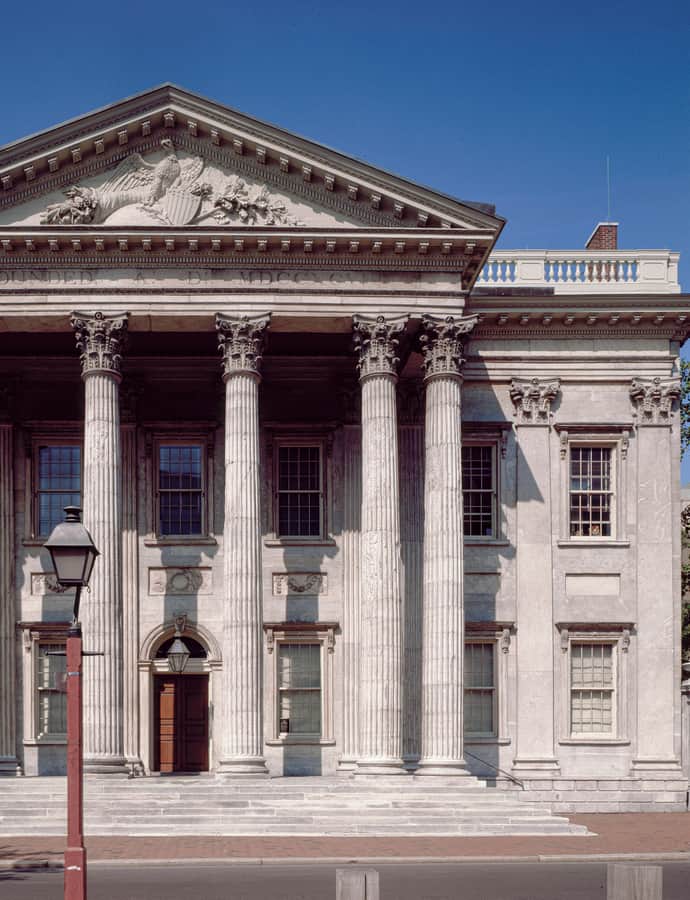

The First Bank of the United States was chartered by Congress in 1791 for a twenty-year term, the brainchild of Treasury Secretary Alexander Hamilton, who argued a national bank was necessary to stabilize the young nation's credit and manage its finances under the new Constitution. Its building, completed in 1795, was designed by Samuel Blodgett in the Greek Revival style — one of the style's earliest landmark examples in America.
the building
Not a central bank, but a national one. Unlike a modern central bank, the First Bank didn't set monetary policy, regulate private banks, or act as lender of last resort. What made it "national" was its charter to operate branches in multiple states and lend directly to the federal government, at a time when other American banks were confined to a single state.
Part of Hamilton's fiscal program. The bank was one leg of a three-part expansion of federal power that Alexander Hamilton championed alongside a federal mint and new excise taxes, all aimed at putting the United States government's finances on stable footing.
the style
Samuel Blodgett designed the bank in the Greek Revival style, making it one of the earliest landmark examples of that style in the United States, years before Greek Revival became the dominant idiom for American civic and financial buildings.
More on Greek Revivalsignificance
The First Bank of the United States building is a National Historic Landmark and is listed on the National Register of Historic Places.
nearby
- Carpenters' Hall
- Merchants' Exchange Building
- United States Custom House
- Second Bank of the United States
- Franklin Court
- Powel House