
Second Bank of the United States
- Architect
- William Strickland
- Year
- 1824
- Style
- Greek Revival
- City
- Philadelphia, PA
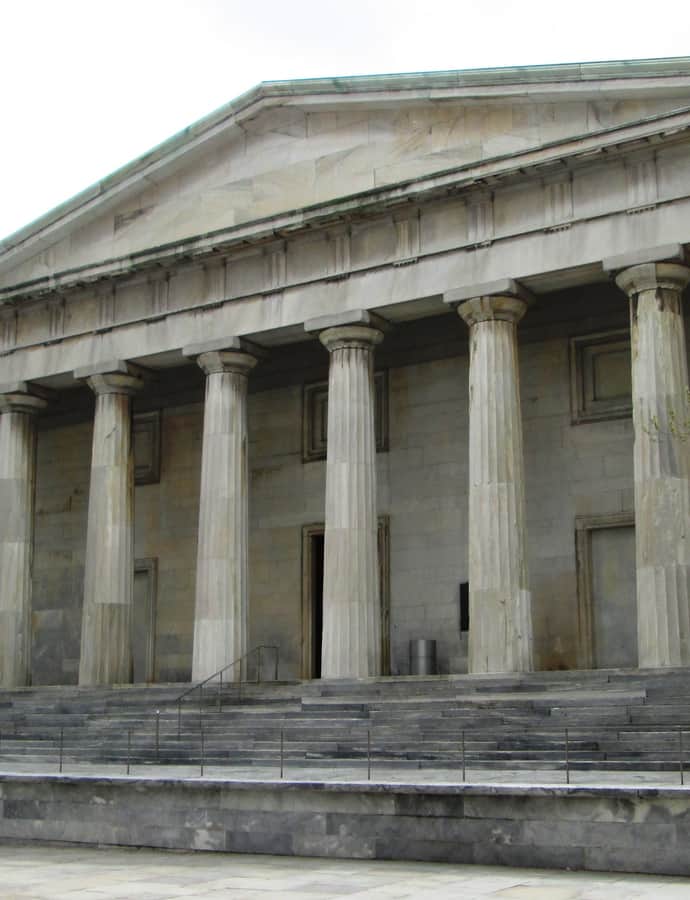

The Second Bank of the United States was chartered under the Madison administration and authorized to operate from 1816 to 1836, a private corporation with public duties that handled all of the federal government's fiscal transactions while answering to Congress and the Treasury. Its Philadelphia building, completed in 1824, was designed by William Strickland — one of America's foremost Greek Revival architects — in a textbook version of that style.
the building
Public duties, private ownership. The federal government owned 20 percent of the bank's capital, making it the single largest stockholder, while 4,000 private investors — including 3,000 Europeans — held the remaining 80 percent, with the bulk of that stock concentrated among a few hundred wealthy Americans.
The world's largest monied corporation. At its peak, the Second Bank was the largest monied corporation in the world, authorized to operate branches across multiple states and lend directly to the U.S. government, unlike ordinary banks confined to a single state charter.
the style
Strickland's Greek Revival design is considered a textbook example of the style, part of a wave of Greek-inspired civic and financial buildings that used classical austerity to project the young republic's financial credibility.
More on Greek Revivalthe architect
William Strickland was one of America's foremost Greek Revival architects; the Second Bank stands as one of his defining works in that style.
significance
The Second Bank of the United States building is a National Historic Landmark and is listed on the National Register of Historic Places.
nearby
- Philosophical Hall
- Carpenters' Hall
- Philadelphia Bourse
- Independence Hall
- First Bank of the United States
- Franklin Court