
Independence Hall
- Architects
- Robert Mills William Strickland Andrew Hamilton Edmund Woolley
- Year
- 1753
- Style
- Georgian
- City
- Philadelphia, PA
- Collection
- colonial & revolutionary
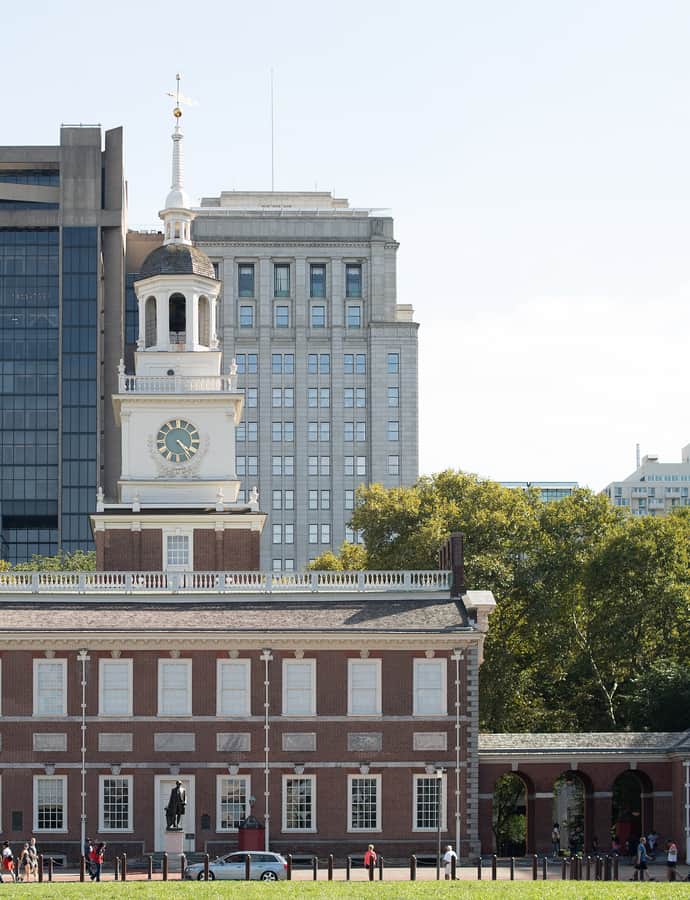

Independence Hall is where the Declaration of Independence and the U.S. Constitution were both debated and adopted, an American Georgian building completed in 1753 as the Pennsylvania State House and the first capitol of colonial Pennsylvania. Even before its founding-era history it was called "the greatest ornament in the town"; it was designated a World Heritage Site in 1979.
the building
Where two founding documents were signed. The Second Continental Congress met here from 1775 to 1781, founding the Continental Army on June 14, 1775, and adopting the Declaration of Independence on July 4, 1776. Eleven years later, from May 25 to September 17, 1787, the building hosted the Constitutional Convention that drafted the U.S. Constitution.
the style
Independence Hall is textbook American Georgian architecture, marked by careful symmetry, classical proportions, and exposed brick set off by stone masonry accents — restrained, formal detailing suited to a colonial seat of government.
More on Georgianthe architect
The building's design and later alterations passed through several hands, including Andrew Hamilton and Edmund Woolley in the colonial era and Robert Mills and William Strickland in later work; the record names them without further biographical detail.
significance
Independence Hall is the centerpiece of Independence National Historical Park and was designated a World Heritage Site in 1979.
nearby
- Philosophical Hall
- Congress Hall
- Second Bank of the United States
- Philadelphia Bourse
- Rohm and Haas Corporate Headquarters
- Carpenters' Hall