
Emmanuel Episcopal Church
- Architect
- Henry Hobson Richardson
- Style
- Romanesque Revival
- City
- Pittsburgh, PA
- Collection
- richardson's legacy
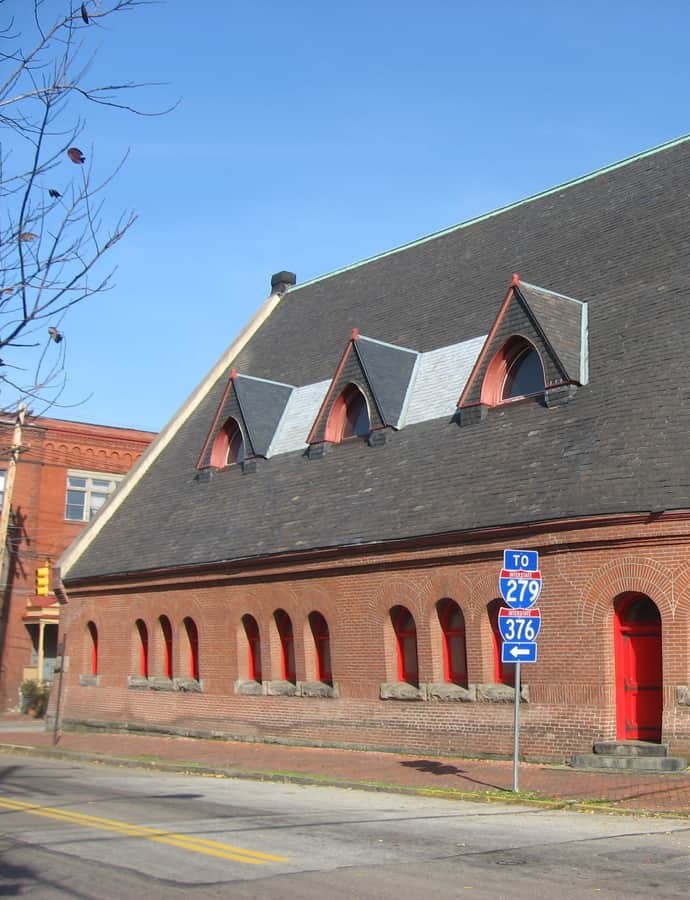

Emmanuel Episcopal Church stands at 957 West North Avenue on the corner of Allegheny Avenue in Pittsburgh's North Side, its 1886 building one of the last designs by Henry Hobson Richardson, the architect whose name became synonymous with Richardsonian Romanesque. It was declared a National Historic Landmark in 2000. The parish remains active today, known for its Sunday evening Jazz Vespers service.
the building
Economical brick, striking result. Brick was chosen for the walls simply because it was the cheaper option, yet it became one of the church's most memorable features. Unlike most of Richardson's work, the wall surfaces here are plain, without the rough textures, moldings, or belt courses he typically used to break up a facade and cast shadow lines.
A string course in brick. Just below the eave line, the bricks step outward from the main wall in two stages of different dimension, producing a subtle projecting band that reads as a string course - achieved entirely in brick rather than applied stone trim.
Stone kept to a minimum. Stone appears sparingly: as sills beneath the windows, springing from the three arched entrances, and where the foundation is exposed. Everywhere else, the plain brick walls carry the design.
the style
Emmanuel Episcopal is a Romanesque Revival design, but an atypical one for Richardson - most of his Romanesque work relies on rough-faced stone and heavy ornament to generate drama, while here the drama comes from the brick itself: plain surfaces relieved only by patterning and the stepped brick string course below the eaves.
More on Romanesque Revivalthe architect
Henry Hobson Richardson gave his name to Richardsonian Romanesque, the round-arched, heavily massed style he developed in works like the Allegheny County Courthouse. Emmanuel Episcopal, completed in 1886, was among his last designs and a rare instance of him working at the scale of a small parish church rather than a civic monument or mansion.
More on Henry Hobson Richardsonsignificance
The church was declared a National Historic Landmark in 2000 and is also listed on the National Register of Historic Places and recognized as a Pittsburgh History & Landmarks Foundation Historic Landmark, distinctions unusual for a building this modest in size.
more by Henry Hobson Richardson
nearby
- Byers-Lyons House
- B. F. Jones House
- House at 200 West North Avenue
- Carnegie Free Library of Allegheny
- John A. Brashear House and Factory
- Frederick J. Osterling Office and Studio