
James Flood Mansion
- Architect
- Augustus Laver
- Year
- 1886
- City
- San Francisco, CA
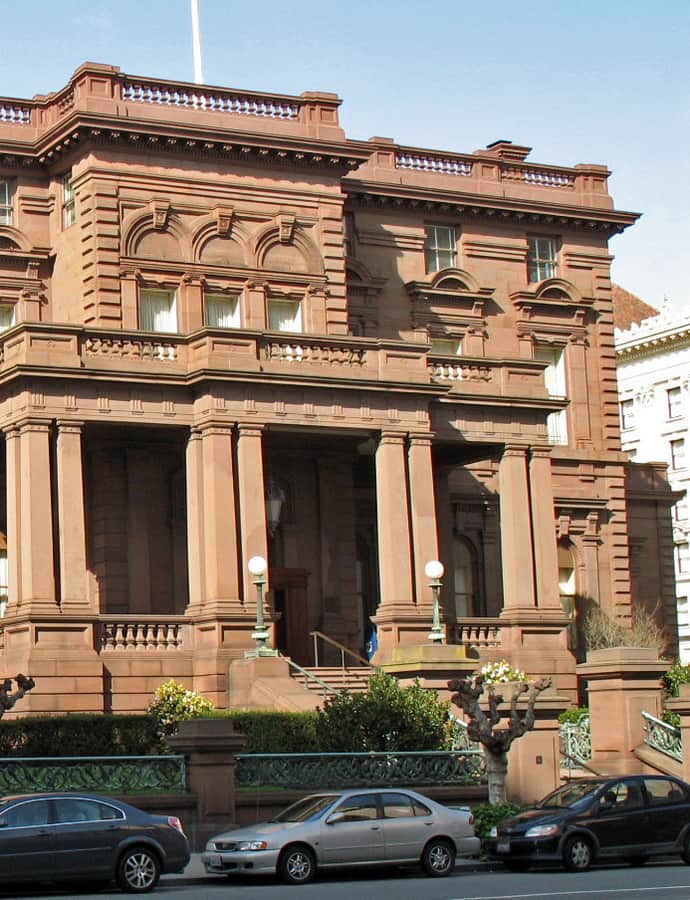

The James C. Flood Mansion was built in 1886 atop Nob Hill as the townhouse of silver baron James C. Flood, designed by Augustus Laver as the first brownstone building west of the Mississippi River. It was the only Nob Hill mansion to structurally survive the 1906 earthquake and fire, and it has served as the home of the Pacific-Union Club since. It was declared a National Historic Landmark in 1966.
the building
Brownstone from Connecticut. The three-story masonry mansion is clad in brownstone quarried in Portland, Connecticut, and shipped around Cape Horn to San Francisco — the material that made it the first brownstone building west of the Mississippi.
A whole city block. The Flood Mansion occupies an entire block bounded by California, Cushman, Mason, and Sacramento streets, enclosed on three sides by the original bronze fencing installed when the house was built.
Classical Revival portico. The California Street entrance is sheltered by a broad, deep three-bay portico on clustered square columns, part of a Classical Revival exterior with corner quoining, a balustraded roofline, and windows framed by pilasters and pediments.
the style
The mansion is an elaborate expression of Classical Revival architecture, seen in its quoined corners, balustraded roof edge, and pedimented window surrounds — a formal vocabulary meant to announce Flood's Comstock silver fortune atop Nob Hill.
significance
The Flood Mansion is a National Historic Landmark and is individually listed on the National Register of Historic Places; it was the only mansion on Nob Hill to survive the 1906 earthquake and fire, and is now home to the Pacific-Union Club.
nearby
- Fairmont San Francisco
- Grace Cathedral
- Metropolitan Club
- 450 Sutter Street
- Old Saint Mary's Cathedral
- San Francisco Fire Department Engine Co. Number 2