
French ambassador's residence in Washington, D.C.
- Architect
- Jules Henri de Sibour
- Style
- Tudor Revival
- City
- Washington, DC
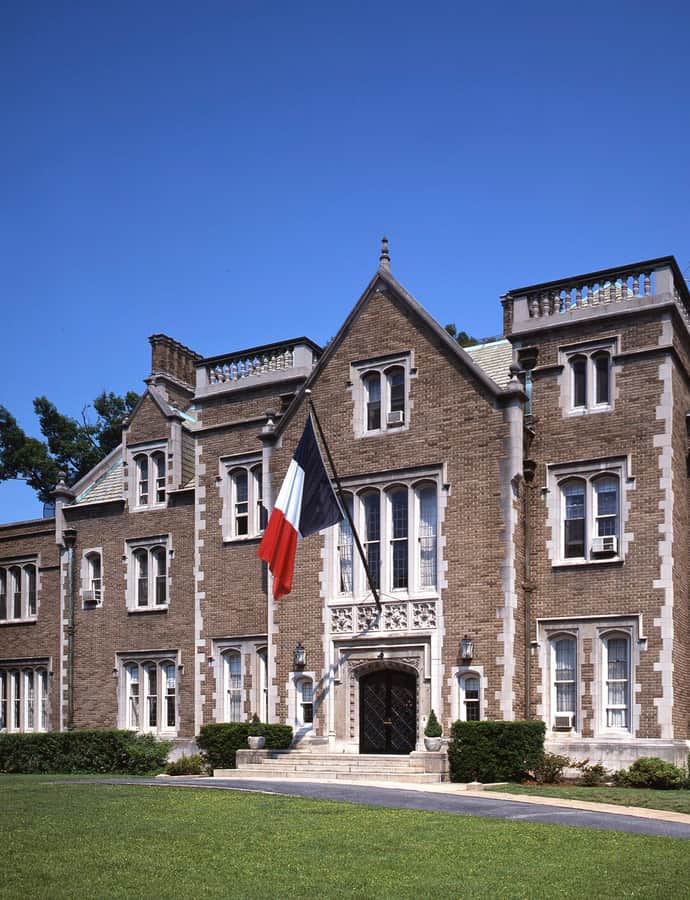
Built in 1910 for paint and white-lead manufacturer William Watson Lawrence, this Tudor Revival mansion in Kalorama later became the home of mining millionaire John Hays Hammond before the French government bought it in 1936. It served as the French chancery for nearly fifty years, until a new embassy on Reservoir Road opened in 1985, consolidating a diplomatic staff of 400 that had been working out of ten scattered offices around the city.
the building
The Kalorama grounds. The French government expanded the property in 1941 by buying additional lots overlooking Kalorama Circle, growing the estate to 3.6 acres. The grounds have since been pared back: in 2017 the government sold off a separate 0.58-acre tract.
the style
The house is built in the Tudor Revival style, one of several historicist idioms Beaux-Arts-trained architects like de Sibour turned to for prestige residential commissions in early-20th-century Washington.
More on Tudor Revivalthe architect
Jules Henri de Sibour was a French-born, Beaux-Arts-trained architect who became one of the sought-after designers of grand residences in early-20th-century Washington; this house was among his commissions for the city's elite.
significance
The French government has owned the property since 1936, using it as its Washington chancery until 1985 and continuing to hold it today as the ambassador's official residence.
nearby
- Frances Perkins House
- Lothrop Mansion
- Wilson, Woodrow House
- Islamic Center of Washington
- Codman-Davis House
- Beale, Joseph House (Egyptian Embassy)