
Stata Center
- Architect
- Frank Gehry
- Style
- Deconstructivism
- City
- Boston, MA
- Collection
- cambridge campus moderns
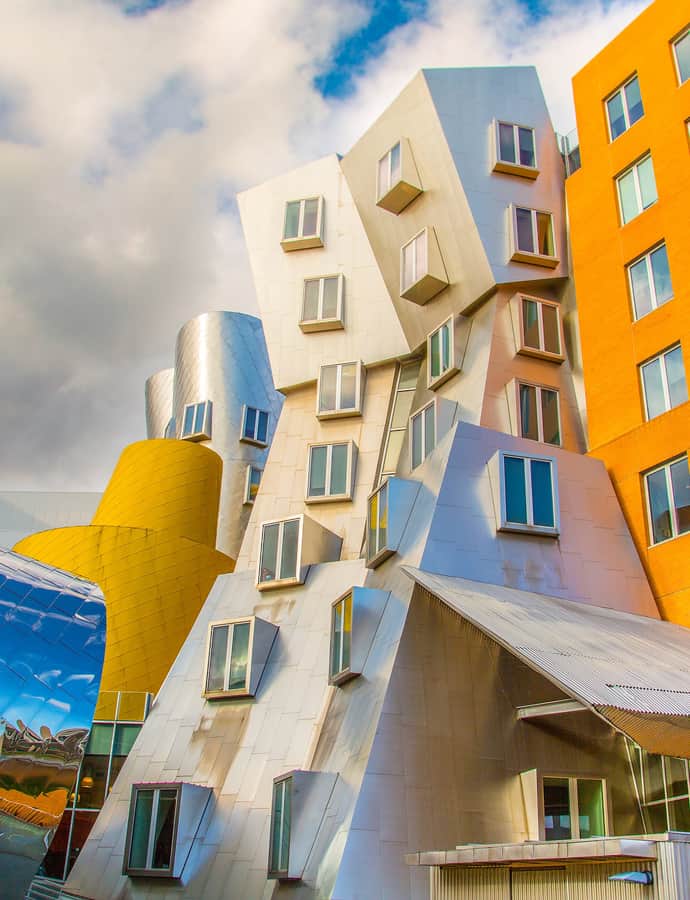

The Ray and Maria Stata Center, designed by Frank Gehry for MIT, opened for initial occupancy on March 16, 2004, on the site of the university's former Building 20, which had housed the historic wartime MIT Radiation Laboratory. The 430,000-square-foot academic complex, plus a 290,000-square-foot underground garage, breaks from MIT's tradition of referring to buildings by number alone: everyone just calls it "Stata."
the building
Two towers, one building. Above the fourth floor, the complex splits into two distinct structures, the Gates Tower and the Dreyfoos Tower, known informally as G Tower and D Tower.
Built over a radiation lab's legacy. Stata rose on the footprint of MIT's former Building 20, which had once housed the historic wartime MIT Radiation Laboratory.
Home to EECS. The complex holds small auditoriums and classrooms used by MIT's Electrical Engineering and Computer Science department (Course 6), along with research labs and offices for the Computer Science program.
the style
Stata is a deconstructivist design by Gehry; its tilting, folding towers were widely cited as a structurally unconventional departure from typical academic building typology.
More on Deconstructivismthe architect
Frank Gehry, a globally significant architect, designed the Stata Center for MIT.
More on Frank Gehrysignificance
The building's cost overruns and unconventional design became a widely discussed and retold controversy, part of what has made Stata one of MIT's most talked-about contemporary buildings.
more by Frank Gehry
nearby
- Green Building
- Wiesner building
- MIT Chapel
- Kresge Auditorium
- Arthur D. Little Inc., Building
- Margaret Fuller House