
Solomon R. Guggenheim Museum
- Architect
- Frank Lloyd Wright
- Year
- 1937
- Style
- Mid-Century Modern
- City
- Manhattan, NY
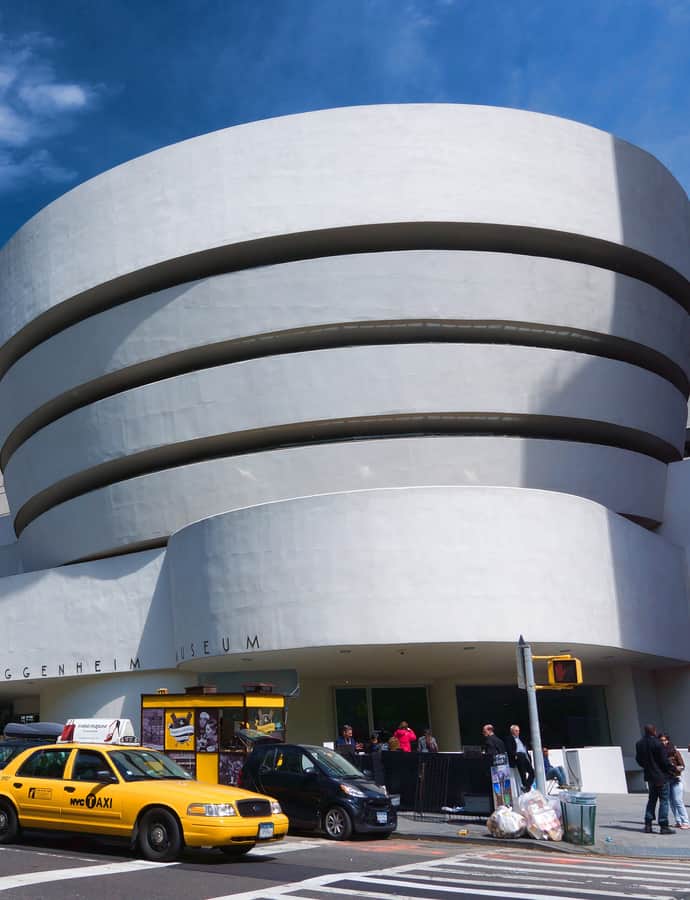

The Solomon R. Guggenheim Museum at 1071 Fifth Avenue was designed by Frank Lloyd Wright and completed in 1959, after 15 years of design and construction. It was established by the Solomon R. Guggenheim Foundation, first opening in 1939 as the Museum of Non-Objective Painting under founding director Hilla von Rebay, and took its current name in 1952 after Guggenheim's death. The building's unconventional shape drew controversy at the time and remains one of the most recognizable museum designs in the world.
the building
The spiral ramp. A six-story helical ramp winds along the perimeter of the bowl-shaped main gallery, under a central ceiling skylight, letting visitors view art while descending a continuous spiral rather than moving room to room.
Building layout. The complex consists of the six-story, bowl-shaped main gallery to the south, a four-story 'monitor' section to the north, and a ten-story annex to the northeast.
the style
The museum is a landmark work of modern architecture, and its design was controversial in its day for the unusual shape of its display spaces, a break from the conventional rectangular gallery.
More on Mid-Century Modernthe architect
The museum was designed by Frank Lloyd Wright.
More on Frank Lloyd Wrightsignificance
The building is a New York City Individual Landmark (LP-01774), designated August 14, 1990, and is also a National Historic Landmark, listed on the National Register of Historic Places and the New York State Register of Historic Places, and part of a UNESCO World Heritage Site.
more by Frank Lloyd Wright
nearby
- Andrew and Louise Carnegie House
- 1261 Madison Avenue Apartments
- Otto and Addie Kahn House
- James A. and Florence Sloane Burden House
- John Henry and Emily Vanderbilt Sloane Hammond House
- Consulate-General of the Russian Federation in New York